Quick answer
How should a hospital plan its digital marketing?
Digital marketing for hospitals works best when you plan it department by department. Build clear pages for each speciality and doctor, keep a correct Google Business Profile, run careful search ads for key services, answer on WhatsApp quickly, ask for honest reviews and track real appointments. Never make cure claims or share patient data without written consent.
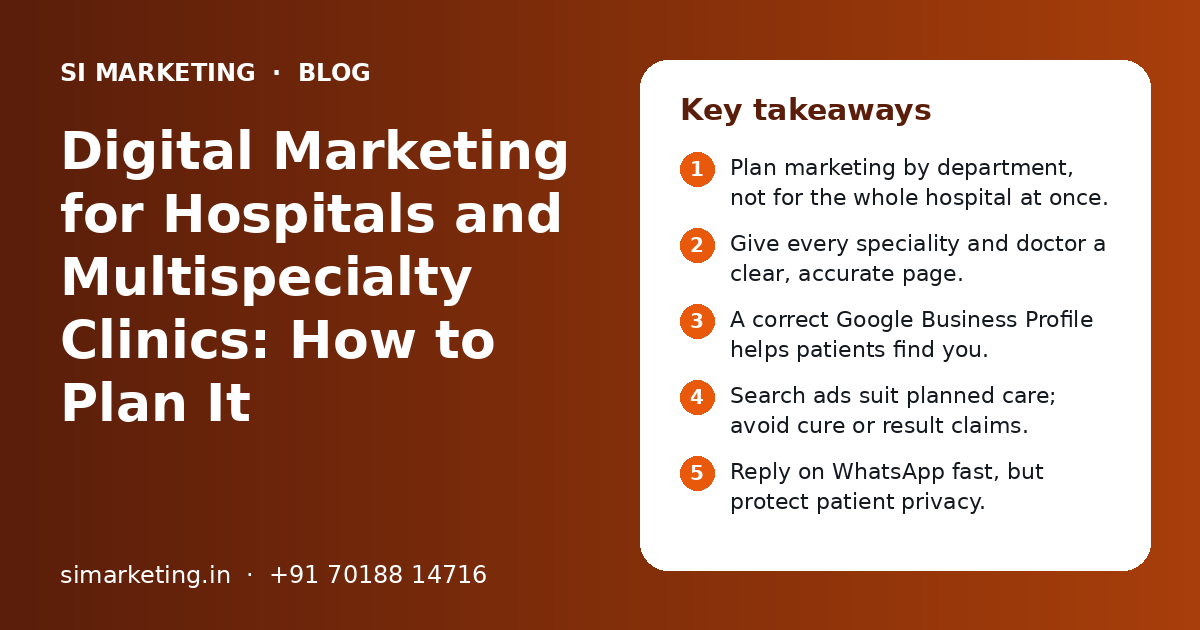
Key takeaways
- Plan marketing by department, not for the whole hospital at once.
- Give every speciality and doctor a clear, accurate page.
- A correct Google Business Profile helps patients find you.
- Search ads suit planned care; avoid cure or result claims.
- Reply on WhatsApp fast, but protect patient privacy.
- Track booked appointments, not clicks or likes.
What is digital marketing for hospitals, and how is it different?
Digital marketing for hospitals is the use of search, maps, ads, WhatsApp, content and reviews to help patients find the right department or doctor and book a visit. It is different from clinic marketing because a hospital has many services, many doctors and a much bigger duty of care.
Its cardiology, orthopaedics, gynaecology, paediatrics and health check teams each have different patients, different search terms and different busy hours. One generic "best hospital" ad does not help any of them.
Hospitals also carry more risk. A wrong claim, a leaked report or a careless photo can hurt patients and the hospital's name. For the wider picture of health marketing, read our page on healthcare digital marketing.
Where should a hospital start with its marketing plan?
Start by choosing two or three departments that need more patients and have the capacity to see them. Then fix the basics for those departments before you spend on ads.
- 1
Pick the priority departments
Ask management which services have free OPD slots, free beds or new equipment. Start there, not with every department.
- 2
List what patients search for
Write down the real words people use, such as "knee replacement surgeon", "child specialist near me" or "full body check-up", plus your area name.
- 3
Check your online basics
Look at your website, Google Business Profile, doctor pages, phone numbers and timings. Fix anything wrong or missing.
- 4
Set up an approval process
Decide who checks medical content and ads. Usually this is a senior doctor from the department plus someone from management.
- 5
Set up tracking
Make sure every call, WhatsApp chat and form can be traced to a channel and a department.
- 6
Launch, review and expand
Run the plan for these departments, review results monthly, then add the next departments.
Which channels should a hospital use, and for what?
Most hospitals get steady patients from Google search and Maps, faster bookings from search ads, and trust from reviews and helpful content. Social media and WhatsApp support awareness and booking.
| Channel | Main job for a hospital | What to track |
|---|---|---|
| Website and department pages | Explain each speciality, doctor and service clearly | Calls, WhatsApp clicks and form fills per department |
| Google Business Profile | Show up on Maps for nearby searches | Calls, direction requests, website visits |
| SEO | Rank for treatment, doctor and area searches | Visits and enquiries from search |
| Google search ads | Catch people actively looking for a service | Cost per booked appointment |
| Meta (Facebook and Instagram) | Awareness, health camps and check-up packages | Enquiries, with careful targeting |
| Answer questions, share slots, send reminders | Reply time, bookings, no-shows | |
| Reviews | Build trust before the first visit | New reviews, rating, reply rate |
How can a hospital improve its Google Business Profile and SEO?
A hospital improves its Google presence by keeping its Google Business Profile complete and correct, and by building one clear website page for each department and each doctor. Patients then find the right page, not just the home page.
Google Business Profile for hospitals
- Correct hospital name, address, main phone number and opening hours
- Separate emergency number shown clearly, if you offer emergency care
- Real photos of the entrance, reception, parking, wards and OPD areas, with no patient faces
- Services listed by department
- Answers to common questions, such as parking, insurance help and visiting hours
- A calm, polite reply to every review
Our local SEO team can help you clean up duplicate or wrong listings for the hospital and its doctors.
Website pages that help patients
Each department page should explain the conditions treated, the main procedures, the doctors, OPD days and how to book. Each doctor page should show real qualifications, experience in plain words, languages spoken and OPD timings. Write in simple English and, where your patients need it, in Hindi, Punjabi or your local language. Our SEO service covers page structure, speed and search terms for each department.
How should a hospital use Google Ads and Meta ads safely?
Use Google search ads for planned services people already look for, such as health check-ups, specialist consultations or planned procedures. Use Meta ads mainly for awareness, health camps and packages, and keep all ad words factual.
Search ads work well for a hospital because they show up when someone is already looking. Group your campaigns by department, so you can see which services bring real bookings. Send each ad to the matching department page, not the home page. Our Google Ads team builds campaigns this way, with call tracking for each department.
On Facebook and Instagram, you cannot target people based on their health conditions, and your ads should not suggest that you know a person's health status. Keep ads general: a health camp in your area, a check-up package, or a doctor sharing simple advice. Our Meta Ads team works within these platform rules.
Safe ad wording
- "Book a consultation with our orthopaedics team"
- "Full body check-up packages. See what is included"
- "OPD open Monday to Saturday. Call or WhatsApp to book"
- "Free health camp this Sunday at our hospital"
Wording to avoid
- "Sure cure" or "100% success"
- "Permanent solution" for any condition
- "Are you suffering from diabetes?" (implies you know their health)
- Before-and-after photos without consent and review
Need help with your project?
Talk to the SI Marketing team. Free first call, simple advice, clear quote.
How can WhatsApp help a hospital without risking patient privacy?
WhatsApp helps a hospital answer questions, share OPD slots, confirm appointments and send reminders. Keep it to booking and general information, and do not discuss diagnosis or share reports unless the patient has agreed and your process is secure.
Many patients in India prefer to message rather than call. A WhatsApp button on every department page and ad makes it easy to ask, "Is the cardiologist available on Saturday?" A trained front-desk team can then reply with slots and book the visit.
- Use the WhatsApp Business API with a verified number if you get many chats, so several staff can reply from one number
- Send appointment reminders only to patients who agreed to get them
- Do not send promotional messages to patients who have not opted in
- Train staff not to give medical advice in chat; a doctor should handle that
- Do not share reports, scans or photos in chat unless the patient has asked for it and your process is approved
India's Digital Personal Data Protection Act, 2023 applies to personal data, and health details are among the most sensitive. Collect only what you need, explain why, and store it safely. Our WhatsApp marketing team can set up opt-ins, templates and reminders the right way.
What content should a hospital publish?
A hospital should publish simple, accurate content that answers real patient questions, written or reviewed by its own doctors. Good content builds trust and helps search engines and AI tools understand your expertise.
Ask each department for the questions patients ask most. These become blogs, short videos and FAQs. For example:
- What happens during a stress test, and how should I prepare?
- When should a child with fever see a doctor?
- What tests are included in a full body check-up?
- What should I bring for my first OPD visit?
Show the reviewing doctor's name on each article. Avoid scary language and do not promise results. Our content marketing team can plan topics and write drafts for your doctors to approve.
How should a hospital handle reviews and its online reputation?
Ask every patient for an honest review in a simple, polite way, and reply to every review calmly without sharing any medical details. Never buy reviews or offer anything in return for good ratings.
The best moment to ask is after a good experience, such as discharge or a smooth OPD visit. Send a short WhatsApp or SMS message with your review link.
Negative reviews will come. Reply with care. Thank the person, say sorry for the trouble, and ask them to call a named helpdesk number. Do not confirm that the person was a patient or mention any treatment details in public. That protects their privacy.
Our Google review management service sets up review requests, reply templates and alerts.
How do you measure hospital marketing results?
Measure booked and attended appointments per department and per channel. Clicks, likes and followers are only early signs, not results.
| Measure | Why it matters |
|---|---|
| Calls and WhatsApp chats per department | Shows real interest from patients |
| Appointments booked | Shows that your front desk turns interest into visits |
| Appointments attended | Shows the real outcome; no-shows need reminders |
| Cost per booked appointment | Shows which channel gives value for money |
| New reviews and average rating | Shows trust over time |
| Call answer rate and reply time | Missed calls waste your ad budget |
Use call tracking numbers for each channel, UTM links on ads and a simple sheet or CRM where your call centre marks the source and department for each booking. Keep patient details out of marketing reports; use counts only. Our marketing analytics team can set up this tracking and a monthly report.
What mistakes should hospitals avoid, and what affects the cost?
The biggest mistakes are general ads for the whole hospital, cure claims, slow replies and weak tracking. The cost depends on how many departments, locations and channels you include.
Common mistakes
- Sending all ads to the home page instead of the right department page
- Using words like "best", "cure" or "100% result" in ads and posts
- Posting patient photos, names or stories without written consent
- Running ads when the call centre is not ready to answer
- Judging success by likes instead of booked appointments
What affects the cost
The cost of hospital marketing depends on the number of departments and branches, the number of channels, how much content and video you need, the ad budget, and the tracking setup. You get a clear quote after a free call. Read our guide on digital marketing cost in India to understand the main cost factors.
SI Marketing is powered by Shivah Web Tech, a Google Partner and Meta Business Partner team with 11+ years of experience. If you want help with a plan for your hospital, contact us for a free call.
Frequently Asked Questions
Is digital marketing allowed for hospitals in India?
Yes, hospitals can market their services online, but within limits. Medical ethics rules guide how doctors promote themselves, Indian law bars ads that claim to cure certain conditions, and Google and Meta have their own health ad rules. Keep content factual, avoid cure or result claims and protect patient privacy. It is wise to check your plan with a legal advisor.
Which is better for a hospital, SEO or Google Ads?
Both have a place. SEO and Google Maps bring steady patients over time at no cost per click, but they take months to build. Google Ads bring enquiries quickly for planned services such as check-ups or specialist consultations. Most hospitals start ads for a few priority departments while they build SEO, then reduce ad spend where search rankings become strong.
How long does it take to see results from hospital marketing?
Search ads can bring calls within days of going live, if the landing pages and call desk are ready. Google Business Profile changes often help within a few weeks. SEO for department and doctor pages usually takes several months to show steady results. The timeline also depends on your area, competition and how quickly your team approves content.
Should every doctor in a hospital have their own web page?
Yes, it helps. Patients often search for a doctor by name or by speciality. A doctor page with real qualifications, languages spoken, OPD days and a booking button helps them choose and book. Keep the page factual, avoid words like best or top, and update it quickly when timings change or a doctor leaves.
Can a hospital share patient success stories online?
Only with the patient's clear, written consent, and only with care. Remove details the patient does not want shared, avoid promising that others will get the same result and have a doctor review the story. Many hospitals prefer general education content from doctors instead, because it carries less privacy risk and still builds trust.
How should a hospital reply to a negative Google review?
Reply politely and briefly. Thank the person, say sorry for their experience and share a helpdesk number or email so they can talk to someone directly. Do not confirm they were a patient or mention any treatment details in public. Never argue online. Fix the real problem if there is one, because future patients read your replies too.
Is WhatsApp safe for hospital appointment booking?
WhatsApp works well for booking, reminders and general questions when used with care. Use a business account, ideally the WhatsApp Business API for larger teams. Message only patients who have agreed to it, train staff not to give medical advice in chat, and do not share reports unless the patient asks and your process is approved.