Quick answer
How do you measure digital marketing ROI for a small business?
To measure digital marketing ROI, track your total marketing cost, the leads each channel brings and the sales those leads turn into. Then use this formula: profit from marketing sales minus marketing cost, divided by marketing cost, times 100. Check it every month per channel, and judge slow channels like SEO over a longer period.
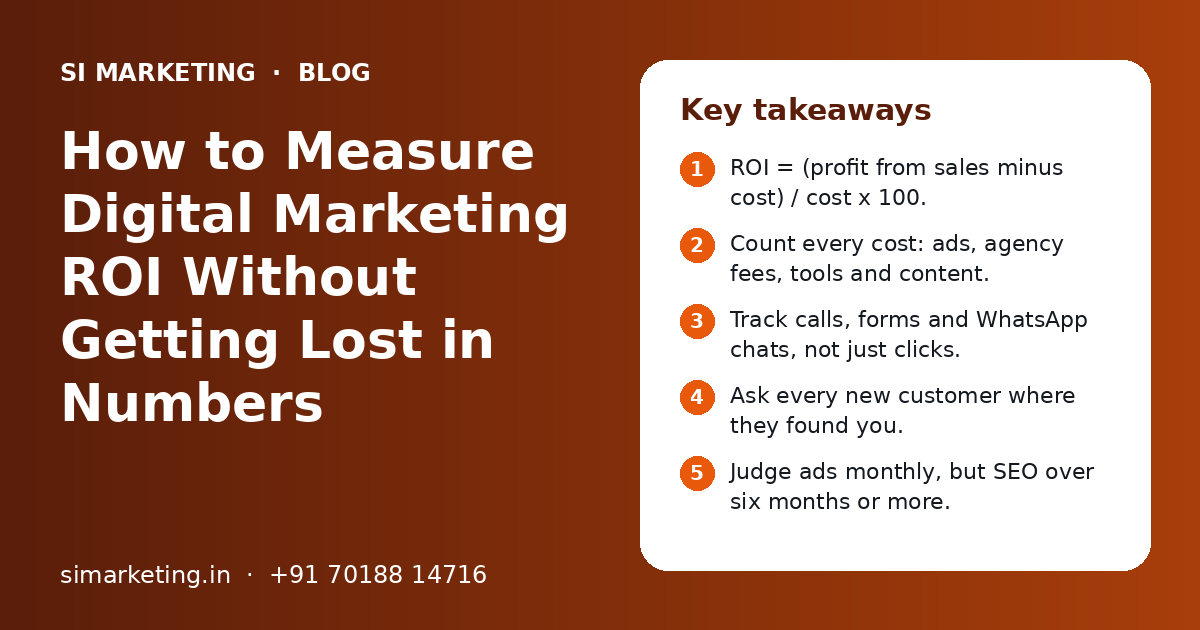
Key takeaways
- ROI = (profit from sales minus cost) / cost x 100.
- Count every cost: ads, agency fees, tools and content.
- Track calls, forms and WhatsApp chats, not just clicks.
- Ask every new customer where they found you.
- Judge ads monthly, but SEO over six months or more.
- Use profit, not revenue, for a true picture.
What is digital marketing ROI and why does it matter?
Digital marketing ROI is the money you earn back from online marketing compared to the money you spend on it. It tells you if your marketing is making a profit or only making noise.
Learning how to measure digital marketing ROI matters because small businesses have small budgets. Every rupee spent on a channel that does not bring sales is a rupee that could go to one that does. Without ROI, you make decisions on feelings, likes and agency reports that only show clicks.
Good measurement starts with good tracking. Our marketing analytics services page explains how we set this up for Indian businesses.
What is the formula to calculate marketing ROI?
The basic formula is: ROI = (profit from marketing sales minus marketing cost) divided by marketing cost, times 100. A positive number means you earned more than you spent.
A simple worked example
Here is a made-up example to show the maths. Say you spent 50,000 rupees in a month on Google Ads, including the agency fee. The ads brought 8 new customers. Your gross profit from those sales, after product or service cost, was 1,20,000 rupees.
- Profit minus cost: 1,20,000 minus 50,000 = 70,000 rupees
- Divide by cost: 70,000 divided by 50,000 = 1.4
- Times 100: ROI = 140 percent
This means every rupee spent came back with 1.4 rupees of extra profit. If the result is negative, the channel cost more than it earned in that period.
Which numbers should you track to measure marketing ROI?
Track five core numbers for each channel: total cost, leads, cost per lead, sales and cost per sale. With these five, you can work out ROI and spot problems quickly.
| Metric | What it means | Why it matters |
|---|---|---|
| Total cost | Ad spend, agency fees, tools, content and design | The real amount you invested |
| Leads | Calls, forms, WhatsApp chats and walk-ins from the channel | Shows if people are interested |
| Cost per lead | Total cost divided by number of leads | Compares channels fairly |
| Conversion rate | Share of leads that become paying customers | Shows lead quality and sales follow-up |
| Cost per sale | Total cost divided by new customers | The number that links to profit |
| Gross profit | Sales value minus product or service cost | Needed for the ROI formula |
| ROAS | Sales value divided by ad spend | Quick check for online stores |
ROAS vs ROI: what is the difference?
ROAS means return on ad spend. It divides sales value by ad spend only. ROI uses profit and includes all costs. An online store can show a good ROAS and still lose money if margins are thin. Use ROAS for daily ad checks and ROI for business decisions.
How do you set up tracking to measure digital marketing ROI?
Set up tracking in a fixed order: goals first, then website tracking, then lead tracking, then a simple sheet or CRM that joins leads to sales.
- 1
Decide what counts as a result
Write down your main actions: a form, a phone call, a WhatsApp chat, a booking or an online order. These are your conversions.
- 2
Set up Google Analytics 4 and Tag Manager
Install GA4 on your website and mark your key actions as conversions, such as form submits and clicks on call or WhatsApp buttons.
- 3
Turn on ad platform tracking
Add conversion tracking in Google Ads and the Meta pixel so each platform knows which ads lead to real actions.
- 4
Use UTM links everywhere
Add UTM tags to links in emails, WhatsApp broadcasts, social posts and influencer bios, so visits show the right source.
- 5
Track phone calls
Use a separate number or call tracking for ads, or at least ask every caller where they heard about you.
- 6
Record every lead with its source
Keep a simple Google Sheet or CRM with date, name, source, status and sale value for each lead.
- 7
Match leads to sales every month
Mark which leads became customers and how much profit they brought. This is the step most businesses skip.
- 8
Calculate ROI by channel
Add up cost and profit for each channel and use the ROI formula. Compare channels side by side.
If your website is slow or has weak forms, fix that too. Better pages turn more of the same visitors into leads. Our conversion rate optimization work focuses on this part.
Need help with your project?
Talk to the SI Marketing team. Free first call, simple advice, clear quote.
How do you track leads that come from WhatsApp, calls and walk-ins?
Track offline and chat leads by using separate numbers or links for each channel and by asking every new customer how they found you. Then record the answer in your sheet or CRM.
In India, many customers do not fill forms. They call, send a WhatsApp message or simply walk in. If you only count form leads, your marketing ROI will look much lower than it really is.
- Use a click-to-WhatsApp link with a pre-filled message for each campaign, such as "Hi, I saw your Instagram offer"
- Track clicks on WhatsApp and call buttons as conversions in GA4
- Use a different phone number for ads if you can
- Train front desk and sales staff to ask "Where did you hear about us?"
- Add a "source" column in your billing or CRM and fill it for every new customer
- Use a simple offer code for each channel, such as a code only shared on Instagram
- Upload offline sales back to Google Ads where it makes sense, so the platform learns which clicks bring buyers
Our WhatsApp marketing services page explains how to run chat-based campaigns that stay trackable. For ads, our Meta Ads agency team sets up click-to-WhatsApp campaigns with clear source tags.
How long should you wait before judging ROI for each channel?
Paid ads can be judged in weeks to a few months, but SEO and content need six months or more. Judging every channel on the same timeline is one of the most common ROI mistakes.
| Channel | When first results usually show | Fair period to judge ROI |
|---|---|---|
| Google Ads (search) | Days to weeks | Two to three months after setup and testing |
| Meta Ads (Facebook and Instagram) | Days to weeks | Two to three months, with new creatives tested |
| SEO | A few months | Six to twelve months |
| Local SEO and Google Business Profile | A few weeks to months | Three to six months |
| Email and WhatsApp to existing customers | Same day to a week | Each campaign, then monthly |
SEO keeps bringing visitors after the work is done, so a fair ROI view looks at a longer time. Our SEO services page explains what this work includes. For paid search, our Google Ads management team reports cost per lead and cost per sale, not only clicks.
Also think about the sales cycle. If your customers take two months to decide, as with real estate or education, last month's leads may buy next month. Match each sale to the month the lead came in.
What tools can a small business use to measure marketing ROI?
Most small businesses only need free tools to start: Google Analytics 4, Google Search Console, the ad platform dashboards and a Google Sheet. A CRM helps once you get many leads each month.
Google Analytics 4
Shows visits, sources and conversions on your website.
Google Tag Manager
Adds tracking for button clicks and forms without changing website code each time.
Google Search Console
Shows how your site appears in Google search and which searches bring clicks.
Google Ads and Meta Ads Manager
Show cost, clicks and conversions for each campaign and ad.
Google Sheets or a CRM
Joins every lead to its source, status and final sale value.
Looker Studio
Puts all your numbers into one simple monthly dashboard.
A clean sheet that is filled every day is more useful than an expensive tool nobody updates. You can learn more on the official Google Analytics site.
What mistakes make marketing ROI look wrong?
The biggest mistakes are leaving out costs, counting clicks as results, trusting each platform's own numbers without checks and not matching leads to real sales. These errors can make a bad channel look good or a good channel look bad.
Good habits
- Include agency fees, tools and content in cost
- Use profit after product cost and GST
- Record the source of every lead
- Judge SEO and content over a longer period
- Review the numbers on a fixed day every month
Common mistakes
- Counting only ad spend as cost
- Using likes, reach or clicks as proof of success
- Adding up sales claimed by Google and Meta, which often count the same sale twice
- Ignoring phone and walk-in leads
- Stopping a channel after a few weeks
Why platform numbers do not match
Google Ads, Meta and GA4 each count conversions in their own way. One customer may click a Meta ad, then search on Google, then buy. Both platforms may claim the sale. Your own sheet or CRM, with the real sale recorded once, should be the final record.
How can you improve digital marketing ROI once you measure it?
Once you can see ROI by channel, move budget toward channels with the best cost per sale, fix weak landing pages and follow up faster with every lead. Small changes in follow-up often matter as much as ad changes.
- Pause ads, keywords or audiences that bring leads but no sales
- Put more budget into campaigns with a low cost per sale
- Reply to every enquiry quickly, ideally within minutes
- Use email and WhatsApp to bring back past customers, which often costs little
- Improve landing pages so more visitors become leads
If you are not sure where to start, a clear plan helps. Our digital marketing strategy work sets goals and budgets by channel, and our performance marketing team runs campaigns built around cost per sale. To compare paid channels, read our post on Google Ads vs Meta Ads.
SI Marketing is powered by Shivah Web Tech, a team with 11+ years of experience and 500+ projects. Costs depend on your channels and goals, and our guide on digital marketing cost in India explains what affects them. You get a clear quote after a free call. Contact us for a free tracking review.
Frequently Asked Questions
What is a good digital marketing ROI for a small business?
There is no single good number, because it depends on your profit margin, industry and how often customers buy again. The simple rule is that ROI should be positive over a fair period, which means the channel earns more profit than it costs. A business with high margins and repeat buyers can accept a lower first-sale ROI than one with thin margins.
How do I calculate ROI on Google Ads?
Add up your Google Ads spend and any agency or tool fees for the month. Then find the new customers who came from Google Ads and the gross profit from their sales. Subtract the cost from that profit, divide by the cost and multiply by 100. Make sure conversion tracking is set up so you know which leads came from ads.
Can I measure ROI for social media marketing?
Yes. Use UTM links in your bio and posts, track WhatsApp and call clicks, and ask every new customer how they found you. Record those sales in a sheet with the source. Organic social media often supports other channels too, so also watch for more branded searches and direct enquiries after strong posts.
Should I use revenue or profit to calculate marketing ROI?
Use profit whenever you can. Revenue includes product cost, delivery, GST and other expenses, so it can make a channel look better than it is. Gross profit, which is sale value minus the direct cost of the product or service, gives a truer picture. Use revenue-based ROAS only as a quick daily check for ads.
How do I measure SEO ROI when results take months?
Track SEO leads and sales over six to twelve months, not one month. Use GA4 to see visits and conversions from organic search, and Search Console to see impressions and clicks. Compare total SEO cost over that period with total profit from SEO customers. SEO traffic often keeps coming after the work, so the return grows with time.
Why do Google Ads and Meta show more sales than I actually made?
Each platform counts a sale if a person interacted with its ad within a set time before buying. If one buyer saw a Meta ad and clicked a Google ad, both may claim the sale. That is why your own CRM or sales sheet should be the final record. Count each real sale once and match it to its main source.
Do I need expensive software to measure marketing ROI?
No. Many small businesses start with free tools like Google Analytics 4, Tag Manager, Search Console, ad dashboards and a Google Sheet. The important part is a daily habit of recording each lead and its source, then marking which ones bought. Paid CRM software helps later when you have many leads and a sales team.