Quick answer
How do you make a product launch marketing plan for a small business?
A product launch marketing plan is a written schedule of what you will do before, during and after launch. Start with your buyer and their problem, set one clear goal, then build interest with a waitlist, prepare your website and ads, run a focused launch week and follow up with every lead and buyer for at least 90 days.
Key takeaways
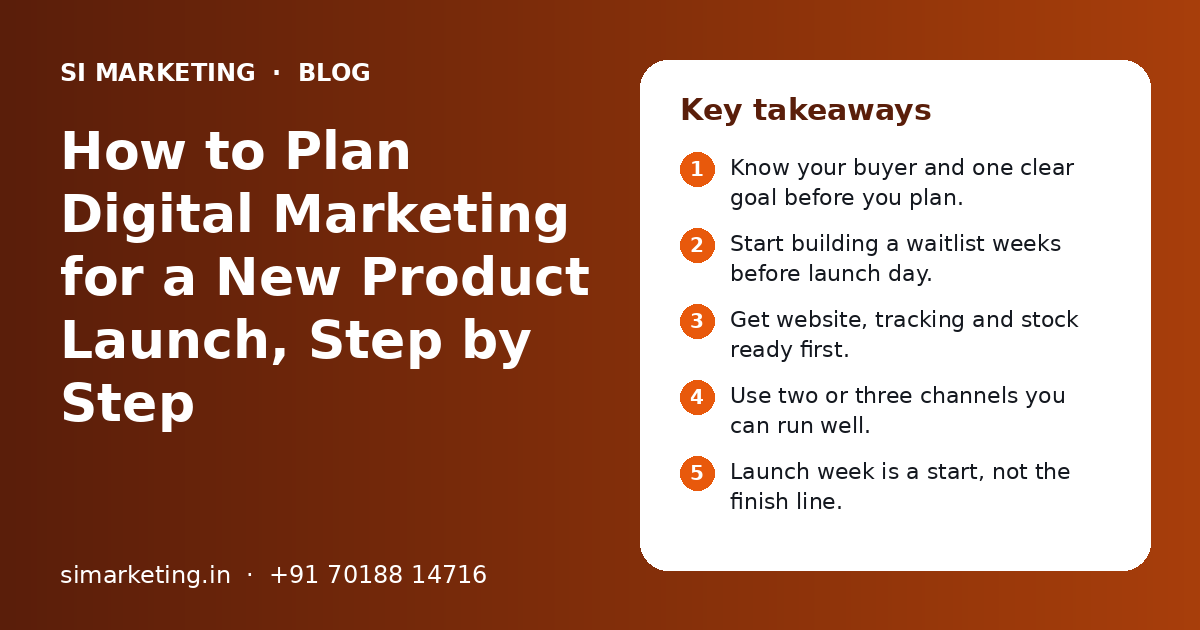
- Know your buyer and one clear goal before you plan.
- Start building a waitlist weeks before launch day.
- Get website, tracking and stock ready first.
- Use two or three channels you can run well.
- Launch week is a start, not the finish line.
- Review numbers weekly and fix what is weak.
What is a product launch marketing plan?
A product launch marketing plan is a simple document that lists what you will do to tell people about a new product, on which channels, by which date and who is responsible. It covers the weeks before launch, launch week and the months after.
Many small businesses skip this step. They post once on Instagram and wait. A plan does not need to be long. Two or three clear pages are enough.
A launch plan is a smaller, time-bound part of your wider digital marketing strategy. The strategy sets long-term direction. The launch plan turns that direction into dated actions for one product.
What should you do before writing the launch plan?
Before you plan any posts or ads, get clear on three things: who the buyer is, what problem the product solves for them and what result you want from the launch. Everything else depends on these answers.
Know your buyer
Write a short profile of the person most likely to buy: age, city, language and where they spend time online. Young metro buyers may need Instagram. Shop owners in smaller towns may respond better to WhatsApp and local dealers.
Talk to real people
Speak to a few people who fit your buyer profile. Ask what they use today and what annoys them. Use their exact words in your ads.
Set one main goal
Pick one main goal for the first 90 days, such as orders, qualified leads, dealer sign-ups or demo bookings. One goal keeps decisions simple.
- One-line description of who the product is for
- The main problem it solves, in the buyer's own words
- Two or three reasons it is better than what buyers use now
- Price range and margin after GST, delivery and fees
- One main goal for the first 90 days
- Three to five competitors and how they sell
What are the steps to plan digital marketing for a product launch?
Plan your launch in eight steps, from message to follow-up. Each step builds on the one before, so do them in order.
- 1
Write your core message
Sum up in one sentence what the product does and why it matters to the buyer. Keep it simple enough to use in an ad, a WhatsApp message and a reel caption.
- 2
Choose your launch date and work back
Pick a realistic date. Avoid clashing with your busiest season unless the product is made for it. Then plan each task backwards from that date.
- 3
Get your website or product page ready
Add clear photos, a short video, price, delivery details, UPI and card payment, returns policy and a visible WhatsApp button. Test it on a phone.
- 4
Set up tracking
Install Google Analytics 4, the Meta pixel and Google Ads conversion tracking. Mark orders, forms and WhatsApp clicks as conversions.
- 5
Build a waitlist
Collect names, phone numbers and emails from people who want early access or a launch offer. This list becomes your first group of buyers.
- 6
Prepare content and ads
Make product photos, short videos, posts, ad creatives and email and WhatsApp messages before launch, so launch week is about running, not making.
- 7
Run launch week
Message your waitlist first, then switch on ads, publish posts and share with partners. Watch numbers every day and reply to every query fast.
- 8
Follow up for 90 days
Collect reviews, retarget visitors, test new ads and improve the product page based on what buyers ask. Most of the long-term sales come from this stage.
If you sell directly to customers online, see our D2C brand marketing page.
What does a product launch timeline look like?
A simple launch timeline runs over about four months: six weeks of preparation, two weeks of pre-launch buzz, one launch week and about 90 days of follow-up. You can shorten or stretch it based on your product.
| Stage | When | Main tasks | What to measure |
|---|---|---|---|
| Research and setup | 6 to 8 weeks before | Buyer research, message, website, tracking, content shoot | Tasks done on time |
| Pre-launch buzz | 2 to 4 weeks before | Teaser posts, waitlist page, early ads, partner talks | Waitlist sign-ups and cost per sign-up |
| Launch week | Launch day plus 7 days | Waitlist offer, ads live, email and WhatsApp, PR and partners | Orders or leads, cost per sale, site conversion rate |
| Early growth | Weeks 2 to 6 | Reviews, retargeting, new creatives, fix product page | Repeat visits, reviews, cost per sale trend |
| Steady state | Weeks 7 to 13 | Scale what works, stop what does not, plan next offer | Profit per order, repeat purchase, total sales vs goal |
Do not rush the setup stage. A broken checkout on launch day wastes the attention you built.
Which channels should a small business use for a product launch?
Choose two or three channels where your buyers already spend time, and run them well. For most small Indian businesses, that means a mix of Meta Ads, Google Search, WhatsApp and your own list.
| Channel | Best use in a launch | Good fit for |
|---|---|---|
| Meta Ads (Facebook and Instagram) | Create awareness and interest with videos and offers | Consumer products, D2C brands, lifestyle and food |
| Google Search Ads | Catch people already searching for a solution | Products people search for by name or problem |
| Message your waitlist, answer questions, close sales | Almost every Indian business | |
| Share launch news and offers with an existing list | B2B products and brands with past customers | |
| Influencers and creators | Show the product in real use to a trusted audience | Beauty, fashion, food, gadgets, fitness |
| Marketplaces | Reach buyers who shop on Amazon or Flipkart | Products that compete on search inside marketplaces |
For paid social, our Meta Ads agency team runs launch campaigns with clear tests. For search demand, our Google Ads management team builds campaigns around the problems your product solves. If creators fit your product, read our influencer marketing services page.
Need help with your project?
Talk to the SI Marketing team. Free first call, simple advice, clear quote.
How do you build interest before launch day?
Build interest before launch by giving people a reason to join a waitlist, such as early access, a launch price or a free add-on. Then share useful behind-the-scenes content that keeps them waiting.
Use a WhatsApp or email waitlist
Make a simple page with one form or a click-to-WhatsApp button. Ask only for name and phone number, or email. Tell people what they get for joining and when the product will be ready. Always take clear consent before you send messages, and give an easy way to opt out.
A waitlist gives you buyers on day one. If very few people join, fix the offer before you spend more on ads. Our WhatsApp marketing services page explains how to run broadcast lists the right way.
Pre-launch content ideas
- Short reels showing how the product is made or packed
- A post about the problem the product solves, before showing the product
- A poll asking followers to choose a colour, flavour or name
- Content in Hindi or a regional language if your buyers prefer it
Keep the tone honest. Do not promise features the product does not have.
How do you run launch week?
Run launch week in a fixed order: tell your waitlist first, then switch on ads, then share widely. Check results every day and fix problems the same day.
| Day | Focus | Actions |
|---|---|---|
| Day 1 | Waitlist and loyal customers | Send the launch offer by WhatsApp and email. Post on social pages. |
| Day 2 | Paid ads go live | Start Meta and Google campaigns with two or three creatives each. |
| Day 3 | Proof and answers | Share first buyer photos and answers to common questions. |
| Day 4 | Partners and creators | Creator posts and dealer messages. |
| Day 5 | Fix and adjust | Pause weak ads and move budget to strong ones. |
| Day 6 | Reminder | Remind people who clicked but did not buy. Use remarketing ads. |
| Day 7 | Review | Count orders, cost per sale and top questions. |
Keep someone ready to answer WhatsApp and calls quickly. Many buyers ask one question before they pay.
For people who visited but did not buy, remarketing ads bring them back with a reminder or a review. These often work best from the second or third day of launch.
What should you do after the launch?
After launch, the work moves from attention to steady sales. Collect reviews, keep testing ads, fix the product page and talk to past buyers about repeat orders.
- Ask every buyer for a review on Google, your site or the marketplace
- Turn common questions into a short FAQ on the product page
- Start an email or WhatsApp series for buyers: how to use, care tips, refill reminders
- Plan a second push around a festival or season that fits the product
- Start SEO content on the problem your product solves
Festivals like Diwali can give a product a second wave. Our page on festival marketing campaigns explains how to plan for them early. For repeat orders, our email marketing services help you stay in touch with buyers without paying for ads each time.
How do you measure whether a product launch worked?
Measure a launch against the goal you set at the start, plus cost per sale and profit per order. Likes and views do not show if the launch made money.
| Metric | What it tells you |
|---|---|
| Waitlist sign-ups | If the message and offer were interesting before launch |
| Website conversion rate | If the product page and checkout work well |
| Cost per sale or cost per lead | How much marketing cost for each result |
| Profit per order | If each sale makes money after product cost, GST and delivery |
Review these numbers every week for the first 90 days. Our marketing analytics services set up a simple dashboard so you can see all launch numbers in one place. You can also read our post on how to measure digital marketing ROI.
What mistakes should you avoid in a product launch?
The most common launch mistakes are starting marketing too late, skipping tracking, spreading budget too thin and stopping after launch week. Each one is easy to avoid with a written plan.
Do this
- Start building a waitlist weeks before launch
- Test the website and checkout on a phone
- Keep stock or service capacity ready for demand
- Reply to every enquiry fast
- Keep a small budget for testing after launch
Avoid this
- Announcing the product on the same day it is ready
- Running ads with no conversion tracking
- Spending the full budget in the first three days
- Using only one ad creative
- Judging the whole launch on day one
Costs for a launch depend on the number of channels, content needed, ad budget and how long you want support. Our guide on digital marketing cost in India explains what affects them. SI Marketing is powered by Shivah Web Tech, which has 11+ years of experience, a 25+ in-house team and 500+ projects. You get a clear quote after a free call. Contact us to plan your launch.
Frequently Asked Questions
How early should I start marketing a new product?
Start about six to eight weeks before launch for setup and research, and two to four weeks before for public pre-launch content and a waitlist. This gives you time to fix the website, test the message and gather early interest. Products that need a lot of explaining need more time.
Can I launch a product online with a small budget?
Yes. Focus on low-cost steps first: a clear product page, a WhatsApp waitlist, posts on your own social pages, messages to past customers and a few honest creator partnerships. Then add a small paid ad budget on one platform where your buyers spend time. Increase spend only after you see which ads bring real sales.
Which is better for a product launch, Instagram or Google Ads?
It depends on whether people already search for your type of product. If they do, Google Search Ads catch that demand. If the product is new or visual, Instagram and Facebook ads are better for creating interest. Many launches use both: Meta Ads to make people aware, and Google Search to catch people who then look it up.
How long does a product launch campaign last?
The main launch week is about seven days, but a full launch campaign usually runs for around 90 days. The first weeks build awareness. The next weeks focus on reviews, retargeting and testing new ads. After that, the product moves into your regular marketing plan, with extra pushes around festivals or seasons.
What should a product launch checklist include?
A good checklist includes buyer research, a one-line message, a tested product page with payment and delivery details, GA4 and pixel tracking, a waitlist, ready content and ads, a launch week schedule, a team to answer WhatsApp and calls, stock checks and a weekly review plan.
Do I need an agency to plan a product launch?
Not always. A small business with time and basic skills can follow a simple plan on its own. An agency helps when you need ads, tracking, content and follow-up to run together on a tight timeline, or when your team is busy with production and sales. Ask any agency how they will measure cost per sale, not only reach.