Quick answer
How do you write Google Ads ad copy that works?
To write Google Ads ad copy that works, start with the exact search you want to show for. Put that phrase in a headline, add a clear benefit, a reason to trust you and a simple call to action. Write several headlines and descriptions, add sitelinks and callouts, then test and keep the lines that bring real leads.
Key takeaways
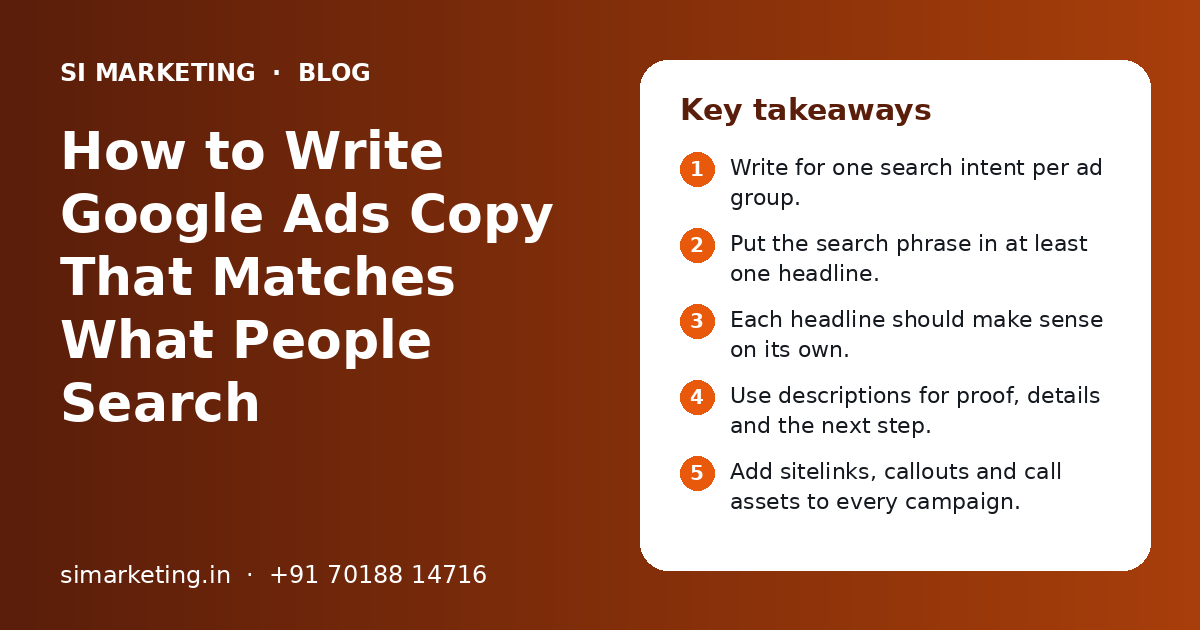
- Write for one search intent per ad group.
- Put the search phrase in at least one headline.
- Each headline should make sense on its own.
- Use descriptions for proof, details and the next step.
- Add sitelinks, callouts and call assets to every campaign.
- Judge copy by leads and sales, not by clicks alone.
What is Google Ads ad copy and why does it matter?
Google Ads ad copy is the text people read in your search ad: the headlines, the descriptions, the display path and the extra assets. Learning how to write Google Ads ad copy well matters because these few words decide who clicks, and every click costs you money.
Good copy does two jobs. It attracts the right people, and it puts off the wrong people. A clinic that writes "Book a Consultation" will get fewer "free advice" clicks than one that writes "Free Tips". That filtering saves budget.
Copy is only one part of a working campaign. Keywords, bids, tracking and the landing page matter too. Our Google Ads management page explains how all these parts fit together.
What are the parts of a Google search ad?
A Google search ad has headlines, descriptions, a final URL, a display path and optional assets such as sitelinks and callouts. Each part has a character limit, so every word must earn its place.
| Part | Limit | What to use it for |
|---|---|---|
| Headlines | Up to 15, each 30 characters | Search phrase, main benefit, offer, brand name, call to action |
| Descriptions | Up to 4, each 90 characters | Details, proof, who it is for, what happens next |
| Display path | 2 fields, each 15 characters | Short words that show where the click goes, like /ac-repair/mohali |
| Final URL | Your landing page link | The page that matches the ad, not just the home page |
| Sitelinks | Short link text plus 2 optional lines | Extra pages like pricing process, reviews, contact |
| Callouts | Short phrases, 25 characters each | Plain facts like "Same-Day Visit" or "GST Invoice" |
| Structured snippets | A header plus a list of values | Lists like services, brands, courses or types |
| Call asset | Your phone number | Lets mobile users call with one tap |
Google does not show every part every time. On a small phone screen, your ad may show only two or three headlines and one description. So the most important lines must work even when shown alone.
How do you match ad copy to search intent?
Match ad copy to search intent by asking what the searcher wants right now and saying exactly that in your headline. One ad group should cover one type of search, so the copy can speak to it directly.
Search intent is the reason behind a search. The same service can be searched with very different goals. Look at these examples for a dental clinic.
| Search | What the person wants | Headline idea |
|---|---|---|
| dentist near me open now | Urgent help today | Dentist Open Today in Mohali |
| teeth whitening cost | Price information | Teeth Whitening: Get a Clear Quote |
| best root canal specialist | Trust and skill | Root Canal by Experienced Dentists |
| dental clinic for kids | A child-friendly place | Gentle Dental Care for Children |
If all four searches go to one ad group with one ad, the copy becomes general and weak. Split them into small ad groups. Then each ad can repeat the searcher's own words back to them.
Read your search terms report first
Before you write, open the search terms report in Google Ads. It shows the real words people typed before clicking your ads. These words are your best copy source. They also show you which searches to block with negative keywords.
How to write Google Ads headlines: a step-by-step method
Write headlines in groups: some with the keyword, some with benefits, some with proof and some with a call to action. This gives Google useful variety while keeping every line on topic.
- 1
Pick one ad group and its main phrase
For example, "AC repair Mohali". All headlines in this ad should relate to this phrase.
- 2
Write 3 to 4 keyword headlines
Use the phrase and close versions of it, such as "AC Repair in Mohali" and "Split AC Repair Service".
- 3
Write 3 to 4 benefit headlines
Say what the customer gets, such as "Technician Visit Same Day" or "Repair at Your Home".
- 4
Write 2 to 3 trust headlines
Use true facts only, such as years in business, partner status or a real review rating.
- 5
Write 2 to 3 offer or action headlines
Tell people the next step, such as "Call Now for a Quick Quote" or "Book a Visit on WhatsApp".
- 6
Add your brand name once
One headline with your business name helps people who already know you.
- 7
Read each headline alone
Delete any headline that does not make sense without the others, or that repeats another line.
Simple rules for headlines
- Use plain words a customer would say out loud.
- Use numbers only when they are true, such as "Open 7 Days" if you really are.
- Avoid all-caps words and extra punctuation. Google may reject them.
- Do not repeat the same idea in five slightly different ways. Give real variety.
- Keep one clear idea per headline.
How do you write good Google Ads descriptions?
Good descriptions add the detail that headlines cannot fit: what is included, who it is for, why to trust you and what happens after the click. Write them as full, short sentences.
A simple four-description plan
- Description 1: The service and the main benefit. "Home AC repair in Mohali and nearby areas. Trained technicians with tools and common parts."
- Description 2: Proof or trust. Use only real facts, like years in business, ratings or partner badges.
- Description 3: The process. "Call or WhatsApp us, get a visit slot, pay after the work. GST invoice available."
- Description 4: The call to action. "Call now or book online in under a minute."
Each description should still make sense if Google shows it with any headline. Do not start a description with "Also" or "And", because it may not follow the line you expect.
Need help with your project?
Talk to the SI Marketing team. Free first call, simple advice, clear quote.
Which ad assets should you add to your copy?
Add sitelinks, callouts, structured snippets and a call asset to almost every search campaign. They make your ad bigger, give more reasons to click and help people go straight to the page they need.
Assets are also copy. Write them with the same care as headlines. A sitelink that says "Click Here" wastes space. A sitelink that says "See AC Service Charges" tells people what they will find.
How should ad copy and the landing page work together?
Ad copy and the landing page must make the same promise. If the ad says "Same-Day AC Repair", the page should say that in its first line and make booking easy.
- The page headline repeats the main words from the ad
- The offer in the ad is visible on the page without scrolling
- The phone number and WhatsApp button work on mobile
- The form is short and asks only what you really need
- The page loads quickly on a normal mobile connection
- Prices, timings and areas match what the ad claims
If your page is slow or confusing, better copy alone will not fix your results. Our conversion rate optimization service looks at the page, form and follow-up together.
How do you test Google Ads copy?
Test Google Ads copy by changing one idea at a time, giving it enough time and clicks, and judging it by conversions and lead quality. Do not judge an ad after a few days or a handful of clicks.
Responsive search ads already test combinations for you. Google shows which headlines and descriptions appear most often. You can also see the ad strength rating. Treat ad strength as a hint about variety, not as a score of real results.
Ways to test
- Run two ads in the same ad group, each with a different main angle, such as speed versus price clarity.
- Use Google Ads experiments to split traffic between an original and a changed campaign.
- Replace weak headlines that rarely show with new ideas, then wait again.
- Compare calls, form leads and WhatsApp chats, not just click-through rate.
Good signs
- More conversions from the same budget
- Leads ask about the service you advertised
- Fewer wrong or junk enquiries
Warning signs
- Click-through rate rises but leads stay flat
- More calls asking for jobs or free help
- People click and leave the page at once
Tracking must be set up before you test. Without it you are guessing. See our marketing analytics page and our guide on how to measure digital marketing ROI.
What mistakes should you avoid in Google Ads copy?
The most common mistakes are writing general copy for many searches, making claims you cannot prove and forgetting a clear next step. Most of them are easy to fix once you look for them.
| Mistake | Why it hurts | Better approach |
|---|---|---|
| One ad for every keyword | Copy becomes vague and less relevant | Small ad groups with their own ads |
| "Best" or "Top" without proof | Can break Google's ad rules and sounds like every rival | Use real facts, such as years or ratings |
| No call to action | People are not sure what to do next | Say Call, Book, Get a Quote or WhatsApp Us |
| Headlines that only work together | Google may show them apart | Make every headline stand alone |
| Same text as competitors | Nothing stands out | Say what is truly different about you |
| Offer not on the page | Visitors feel misled and leave | Match ad and page word for word |
| Never updating copy | Results slowly fade | Review copy every month |
If you run Meta Ads too, the rules for social copy are different. Our post on Meta Ads mistakes small businesses make covers that side.
Should you write ad copy yourself or get help?
You can write your own Google Ads copy if you know your customers well and have time to test. Get help when spend is growing, results are flat or you have no time to review search terms and tests each week.
At SI Marketing, our work is powered by Shivah Web Tech, a Google Partner team with 11+ years of experience and 500+ projects. We write copy as part of full campaign management, with tracking, landing pages and monthly reviews. See our PPC management service. You get a clear quote after a free call.
Frequently Asked Questions
How many headlines should a Google ad have?
A responsive search ad can have up to 15 headlines. It is a good idea to add at least eight to ten real, different ones, so Google has enough options to test. Quality matters more than count. Ten clear headlines on one topic work better than fifteen that repeat the same words.
Should I put the keyword in every Google Ads headline?
No. Put the main keyword or a close version in two to four headlines. Use the rest for benefits, proof, offers and a call to action. If every headline repeats the keyword, the ad looks repetitive and gives the searcher no reason to choose you over the other ads on the page.
What is a good call to action for Google Ads in India?
Pick the action your customers prefer. For local services, Call Now or Book a Visit works well. For many Indian buyers, WhatsApp Us for Details is also natural. For B2B, Get a Quote or Request a Callback fits. Make sure the action you name is easy to do on the page.
Can I write Google Ads in Hindi or other Indian languages?
Yes. Google Ads supports many Indian languages, including Hindi. Set the campaign language to match, and write the ad and the landing page in the same language. Many businesses run separate ad groups for English and Hindi searches, so each ad matches the words the person actually typed.
How often should I change my Google Ads copy?
Review your copy every month. Replace headlines that rarely show or seem to bring poor leads, and update offers, timings and seasonal lines. Do not change everything at once, or you will not know what made the difference. Give each change a few weeks and enough clicks before you judge it.
Does ad strength affect my Google Ads results?
Ad strength is a guide from Google about how much variety and relevance your headlines and descriptions have. It is not a direct measure of sales or leads. A higher rating can help Google test more combinations, but you should judge the ad by conversions, cost per lead and lead quality.
Why is my Google ad getting clicks but no leads?
Common reasons are copy that attracts the wrong people, a landing page that does not match the ad, a slow mobile page, a long form or broken tracking. Check the search terms report, test your form and phone links, and make sure the page repeats the exact offer made in the ad.